
By Edify College of IT · Published · Updated
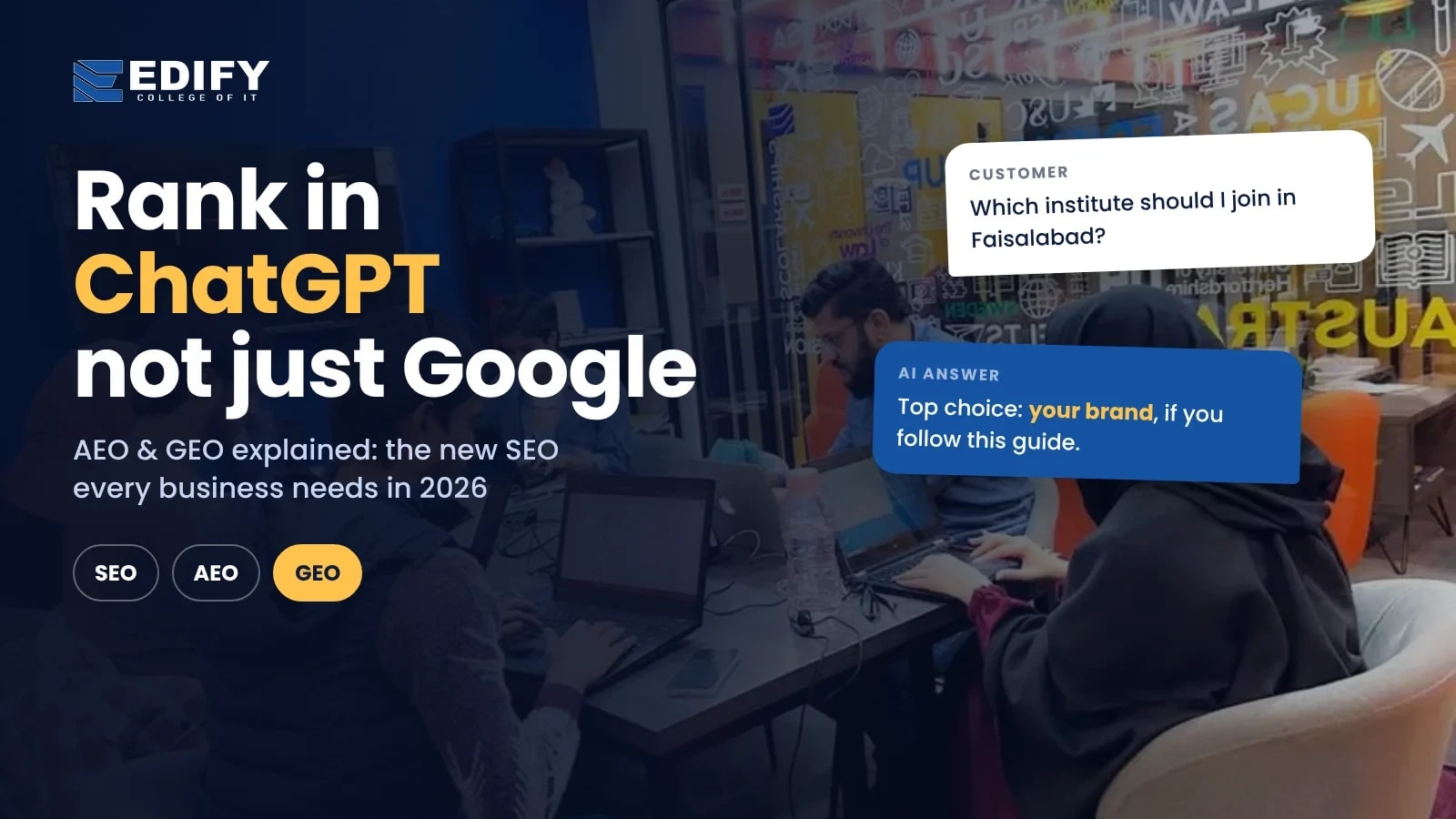
More and more people in Pakistan now ask ChatGPT, Gemini or Google's AI Overview before they click a single website. A student asks "which IT institute in Faisalabad teaches AI?", a shop owner asks "best accountant near Madina Town", and the AI writes the answer itself, naming two or three businesses. If your business is not one of them, the customer may never see you, even when your website ranks well.
That is why two new terms sit next to SEO in 2026: AEO (Answer Engine Optimization) and GEO (Generative Engine Optimization). This guide explains both in plain words and gives you a practical checklist you can apply to your own website or a client's website this week.
What changed in search
Classic search shows a list of ten blue links and the user picks one. AI search works differently: the tool reads several pages, writes one combined answer, and shows a few sources or names inside that answer. Google AI Overviews, ChatGPT search, Gemini, Copilot and Perplexity all work this way.
Normal Google results have not disappeared, and SEO still matters a lot. But the first thing many users read is now an answer, not a list. The question for every business becomes: when an AI answers a question about my field, does it mention me?
SEO, AEO and GEO: the difference
| SEO | AEO | GEO | |
|---|---|---|---|
| Full name | Search Engine Optimization | Answer Engine Optimization | Generative Engine Optimization |
| Goal | Rank high in normal search results | Become the direct answer: featured snippets, People Also Ask, voice answers | Get named or cited inside AI-written answers |
| Where it shows | Google and Bing results pages | Answer boxes at the top of Google, voice assistants | ChatGPT, Gemini, Google AI Overviews, Copilot, Perplexity |
| Main focus | Keywords, content, backlinks, technical health | Clear question-and-answer content, structured data | Trust, clear facts about your brand, mentions across the web |
Think of them as layers, not rivals. AEO and GEO are built on top of good SEO. A slow, badly structured website will not be cited by any AI tool.
How AI tools decide whom to mention
No company publishes the exact rules, and they change often, so be careful with anyone who promises a guaranteed "ChatGPT ranking". What we can see in practice is that AI answers tend to use sources that:
- Answer the question clearly, near the top of the page, in a form that is easy to quote.
- Are easy to understand for a machine: clean headings, lists, tables and structured data.
- Look trustworthy: real business details, named authors, up-to-date facts, no exaggerated claims.
- Are talked about elsewhere: reviews, directory listings, news, social profiles and other websites that mention the same brand with the same details.
- Can be crawled: the page is public, indexed and not blocked by robots.txt.
A practical AEO and GEO checklist
1. Write answer-first content
Start each important page or section with a direct answer of two or three sentences, then explain the details. If someone asks "How long is the DIT course?", the first line should say "DIT is a two-year diploma", not a paragraph of history.
2. Add real FAQs
Collect the questions customers actually ask on WhatsApp, on calls and at your front desk, and answer them on your website in their own words. A good FAQ page is one of the easiest ways to appear in People Also Ask boxes and AI answers.
3. Use structured data (schema markup)
Schema tells search engines exactly what a page is about: an organization, a course, an article, a local business, a FAQ. For a business, the most useful types are Organization or LocalBusiness, plus Course, Article or Product where they fit. Test it with Google's Rich Results Test.
4. Keep one consistent identity everywhere
Your business name, address, phone number and website should be exactly the same on your website, Google Business Profile, Facebook, Instagram, LinkedIn and directories. When an AI finds the same facts in many places, it trusts them. When it finds three different phone numbers, it trusts none of them.
5. Build topical authority
One article does not make you an expert. Cover your main topic from many angles: beginner guides, comparisons, pricing questions, common mistakes and local guides. Link these pages to each other and to your main service page.
6. Earn mentions and reviews
For GEO, being mentioned on other trusted websites matters as much as links. Ask happy customers for Google reviews, get listed in relevant directories, partner with associations and share genuinely useful content that others want to reference.
7. Check the technical basics
- Pages load fast and work well on mobile.
- The site uses HTTPS and has a sitemap submitted in Google Search Console and Bing Webmaster Tools.
- Important pages are indexed and have a correct canonical tag.
- robots.txt does not accidentally block search engines or the AI crawlers you want to allow.
8. Keep facts fresh
Old dates, old prices and courses you no longer offer make a page look unreliable. Review your key pages every few months and update them.
How to check if AI mentions your brand
- Write down ten questions a real customer would ask, for example "best IT institute in Faisalabad for AI courses".
- Ask them in ChatGPT, Gemini, Copilot and Google, and note whether your brand appears and which sources are shown.
- Look at the sources that are cited instead of you. They show what kind of content and which websites the AI trusts for that question.
- Repeat every month and keep a simple sheet, so you can see progress after each change.
Also watch Google Search Console: AI Overview traffic is counted inside the normal Performance report, so growing impressions on question-type queries is a good sign.
Common mistakes to avoid
- Copy-pasting AI-written articles without editing or fact-checking them.
- Stuffing keywords instead of answering the question.
- Hiding the answer below long introductions or pop-ups.
- Different business details on different platforms.
- Buying spammy backlinks or fake reviews. These can harm both Google rankings and trust.
AEO and GEO as a skill you can sell
Most small businesses in Pakistan have not heard of AEO or GEO yet, but they already feel the effect when customers say "ChatGPT suggested another place". That makes it a strong service for freelancers and agencies: an AI visibility audit, FAQ and schema setup, Google Business Profile optimization and monthly reporting can all be offered as packages on Fiverr, Upwork or to local clients.
Learn SEO, AEO and GEO at Edify College of IT
Our AI Powered SEO (SEO : AEO : GEO) course is a six-week, practical course on campus in Faisalabad. You work on real websites: keyword research, on-page SEO, technical SEO with Search Console, local SEO, schema markup and AI search visibility, and you finish with a capstone project and a client-ready report. If you want the full marketing picture, the AI Powered Digital Marketing course combines SEO with social media marketing, Google Ads and ChatGPT Ads.
New to SEO? Start with our guide to on-page SEO, read our FAQ, or apply online for the next batch.
Frequently asked questions
Is SEO dead because of AI search?
No. AI tools still rely on websites that are well optimized, indexed and trusted. SEO is the foundation; AEO and GEO build on it.
What is the difference between AEO and GEO?
AEO focuses on becoming the direct answer, such as a featured snippet or voice answer. GEO focuses on being cited or named inside answers written by generative AI tools like ChatGPT, Gemini and Google AI Overviews.
Can I pay to appear in ChatGPT answers?
There is no way to buy a place inside normal AI answers. Visibility comes from clear content, consistent business information and genuine mentions across the web.
How long does it take to see results?
Technical fixes and FAQ updates can be picked up within weeks once pages are recrawled. Trust and mentions build over months, so treat it as an ongoing process.
Do I need coding to learn AEO and GEO?
No. Basic website editing is enough for most of the work, and schema can be added with tools or plugins. Our SEO course teaches everything step by step.