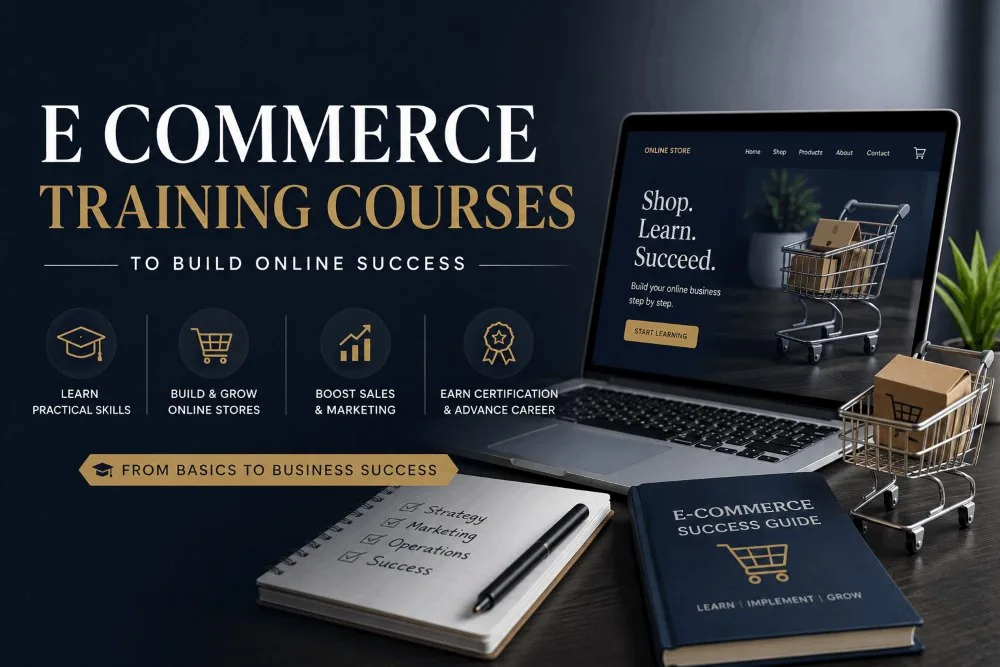
E Commerce Training Courses to Boost Your Career
IT Courses
If you've typed "how do I actually learn this properly" into a search bar after watching yet another confusing tutorial, you already understand why e commerce training courses have become so popular. Selling online looks simple from the outside: list a product, run some ads, watch orders come in. Anyone who's actually done it knows the gap between "watched a video" and "can run a profitable store" is much wider than it looks.
This guide breaks down what a genuinely good training program should teach, how course formats compare, and how to avoid paying for a certificate that looks nice but doesn't translate into real skill.
Why E Commerce Training Courses Matter More Than Ever
Explore these insights and see which method fits your goals best.
Online retail has matured past the point where trial and error works reliably for most beginners. A decade ago, an ambitious seller could stumble into success by being early to a platform. That window has mostly closed.
Platforms reward specialized knowledge. Shopify, Amazon, and WooCommerce each have their own internal logic, and sellers who understand platform-specific mechanics consistently outperform those improvising. This is where structured ecommerce training pays for itself.
Hiring managers screen for verified skills. A resume claiming "ecommerce experience" carries less weight than a completed ecommerce certification course backed by a real portfolio project.
Mistakes cost real money. A mispriced ad campaign or botched inventory forecast can cost thousands before a beginner even realizes what went wrong training compresses that learning curve.
Ecommerce is now a real career track. Roles like ecommerce manager or marketplace specialist increasingly list some form of ecommerce professional training as a preferred qualification.
I've watched sellers spend six months reinventing wheels a single well-taught module would have covered in an afternoon. Structured learning isn't about intelligence it's about not paying for every mistake personally before learning from it.
Types of E Commerce Training Courses You'll Encounter
Discover how this strategy can improve your results today.
Beginner-focused foundational courses cover niche selection, basic unit economics, and first-store setup ideal for anyone starting from zero.
Platform-specific certification tracks, like a Shopify Training Course or Amazon seller training, focus on the exact tools and interfaces of one platform rather than general theory.
Marketing-heavy courses, such as an ecommerce marketing course or ecommerce SEO training, assume you already have a store and want to grow traffic and conversions.
Operations and management courses cover inventory, fulfillment, and customer service the unglamorous side that determines whether a store scales smoothly or collapses.
Cohort-based bootcamps and mentor programs add structure and live accountability, useful for people who learn better under deadlines.
Self-paced online libraries let you move at your own speed, which suits people fitting learning around a job but requires more self-discipline to finish.
Success often depends less on the course itself and more on how it's delivered. A great program can still fall short if its format doesn't match the way you learn best.
What a Quality Ecommerce Certification Course Should Teach
Take a moment to evaluate how these ideas can benefit your situation.
Before enrolling, check whether the curriculum actually covers these core areas if it skips most of them, treat the certificate as decorative rather than substantive.
Niche selection and market validation, using real tools and data rather than gut feeling.
Store setup and platform mechanics real configuration work in Shopify, WooCommerce, or BigCommerce, not just theory slides.
Payment gateway and security basics, including PCI compliance and fraud prevention.
Paid and organic acquisition, from PPC fundamentals to search visibility.
Retention and lifecycle marketing, especially abandoned cart flows and post-purchase email sequences.
Financial literacy margins, cash flow timing, and reading a basic P&L, since cash flow mismanagement kills more stores than lack of sales does.
Customer service and dispute handling, since chargebacks and returns are inevitable.
The strongest programs I've seen spend disproportionate time on the boring middle — operations and cash flow because that's genuinely where most new stores die, not in the marketing chapters everyone assumes matter most.
Choosing Between Live, Self-Paced, and Hybrid Formats
Apply these techniques to gain a stronger competitive advantage.
Live classes offer real-time interaction and built-in accountability useful if you tend to procrastinate alone.
Self-paced courses let you revisit dense modules, like tax or advertising, as many times as needed.
Hybrid programs mix recorded lessons with periodic live sessions, balancing flexibility with structure.
Cohort-based workshops create a peer group, which helps more than expected — troubleshooting a stalled ad campaign feels less discouraging when classmates are solving the same problem in real time.
If you've abandoned online courses before, a live or cohort-based format is usually worth the extra cost simply because you're more likely to finish it.
Platform-Specific Training: Shopify, Amazon, WooCommerce, and Beyond
Explore these insights and see which method fits your goals best.
Generic knowledge only goes so far platform mechanics matter once you're actually running a store.
Shopify training covers theme customization, app stacking, and checkout optimization the standard choice for branded storefronts.
Amazon seller training focuses on FBA logistics, listing optimization, and Amazon's ad auction system.
WooCommerce courses center on WordPress integration and self-hosting control.
Etsy and eBay seller courses address marketplace-specific buyer expectations and platform SEO.
Pick the platform course matching where you'll actually sell great Amazon Training won't help much if your business is a Shopify-based DTC brand.
![]() Marketing and Business Fundamentals Training
Marketing and Business Fundamentals Training
Discover how this strategy can improve your results today.
Ecommerce SEO training builds organic visibility that compounds over time, unlike paid traffic that disappears the moment it stops.
Ecommerce email marketing remains one of the highest-ROI skills taught in any curriculum for existing-customer revenue.
Inventory and logistics training prevents the two most common early failures: stockouts that kill momentum and overstock that ties up cash.
Business setup modules cover legal structuring and supplier decisions before a product ever goes live.
Secure payment systems training keeps checkout friction low while protecting against fraud.
Marketing gets a store noticed; operations keep it alive; a complete program teaches both, not just the exciting half.
Turning Training Into a Career or Credential
Take a moment to evaluate how these ideas can benefit your situation.
Career-focused programs often include portfolio-building, since hiring managers weigh demonstrated project work heavily.
Accredited certifications carry more weight with employers than informal course completions, particularly at larger organizations.
Data-analysis training is increasingly expected reading conversion metrics and customer lifetime value is now a baseline skill, not a bonus.
Final Takeaway
The right E Commerce Training Courses won't just hand you information they compress years of expensive trial and error into a structured, testable curriculum you can apply immediately. Whether you want a beginner-friendly foundation, a platform-specific certification, or a deeper marketing course to sharpen an existing store, the same principle holds: match the program to your actual goal, make sure it covers operations alongside marketing, and choose a format that fits how you genuinely learn. Do that, and the course pays for itself faster than guesswork ever would.
Frequently Asked Questions
What is the best e commerce training course for a complete beginner?
Look for a beginner-focused course that starts with niche validation and basic platform setup before introducing paid advertising.
Are free e commerce training courses worth taking?
They're a reasonable way to test your interest, but usually lack the structured feedback and certification value of paid programs.
How long does an e commerce certification course take?
Most structured programs run 4 to 12 weeks, though self-paced formats can stretch longer based on your availability.
Do employers actually value e commerce certifications?
Increasingly yes, especially when the certification includes a portfolio project rather than just completed coursework.
How much do e commerce training courses typically cost?
Fees range from free introductory content to several thousand dollars for intensive bootcamp or mentor formats, depending on depth and accountability structure.
Recents
E Commerce Training Courses to Boost Your Career
Read Article →
The Best AI Automation Course for Business Growth 2026
Read Article →
NAVTTC Free Courses: Complete Guide to Skill Development
Read Article →
Best IT Institute Faisalabad 2026 The Ultimate Guide to Building a Successful IT Career
Read Article →
Best IT Short Courses in Faisalabad: A Complete Guide for 2026
Read Article →
Python Basics: The Ultimate Step by Step Guide to Master Python Programming
Read Article →